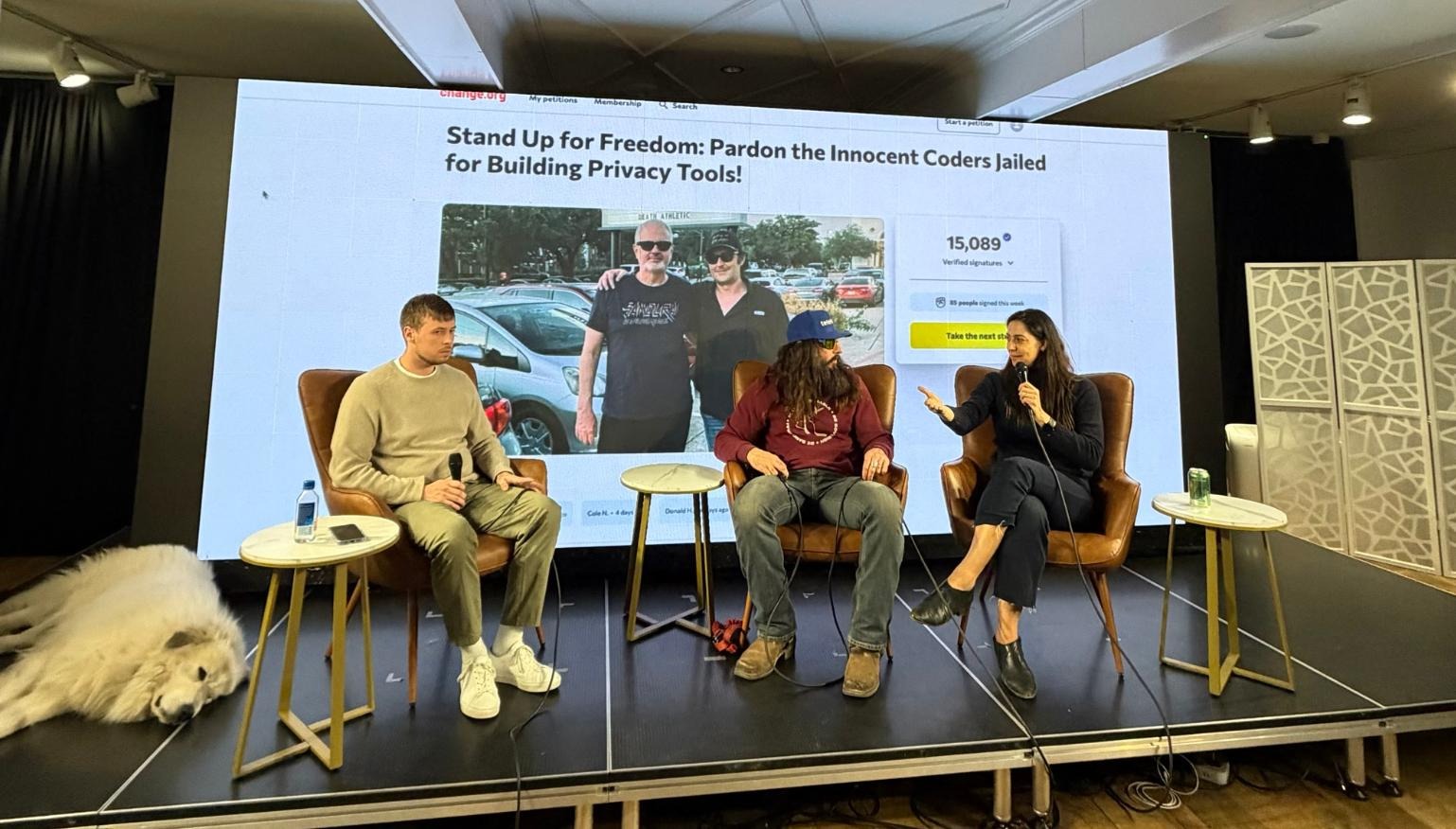
Renata Rodrigues spends her days onboarding activists in communities with no internet access, low literacy, and phones that barely function. As head of field operations at Fedi, a privacy-focused Bitcoin wallet, she has watched people in the most dangerous circumstances immediately upload their real photos and names to platforms that never asked for them. The impulse, she told a Nashville audience, reveals the core problem. Privacy fails not because the tools are absent but because convenience has trained people to surrender personal information reflexively.
Econoalchemist, co-founder of the 256 Foundation, framed the stakes in starker terms. He pointed to the Samourai Wallet case, where two software developers received four- and five-year prison sentences for building a tool that helped Bitcoin users preserve their anonymity on a public blockchain. The prosecution treated code as criminal conduct. Econoalchemist argued the underlying principle remains unresolved: software developers are being held responsible for what end users do with neutral technology.
"Software developers cannot be held responsible for what the end users are doing with that code, just like auto manufacturers are not held responsible when someone does something illegal with that car."
Zack Cohen, a researcher at the Bitcoin Policy Institute in Washington, D.C., acknowledged the policy front is not moving fast enough. The Blockchain Regulatory Certainty Act attempted to protect developers from being classified as money transmitting businesses. But Cohen called it insufficient. One federal statute among thousands, he noted, does nothing about state-level enforcement or novel legal theories regulators invent after the fact. The state of California recently sued a Florida-based 3D-printed firearms company simply because California residents could access the files over the internet. Cohen sees this jurisdictional reach as a template for how privacy tool developers will be targeted next.
"When privacy goes away, all of our freedoms collapse."
Rodrigues brought the conversation back to ground level with a global perspective. She described the travel rule expanding from 64 to 115 countries, creating an international framework where personal financial information crosses borders between governments. In France, she said, the Bitcoin meetup community went from four gatherings to 40 in one year, then dropped to zero after a wave of violent home invasions targeting cryptocurrency holders. The fear, she argued, is not hypothetical. Rodrigues compared uncontrolled internet access for children to dropping them in downtown New York at 3 a.m., a visceral illustration of how digital exposure creates physical danger.
The three panelists converged on a practical prescription rather than a political one. Econoalchemist urged the audience to stop using Google services entirely. Rodrigues recommended starting with encrypted email and resisting the temptation to share real identities on platforms that do not require them. Cohen asked people to simply use the privacy tools that already exist, arguing that adoption in rooms like Bitcoin Park is how network effects shift away from surveillance infrastructure. All three acknowledged the difficulty. Building decentralized privacy tools, Rodrigues said, is far harder than running a centralized exchange. But the alternative is a world where every financial transaction, every communication, and every movement generates a permanent record held by institutions that have proven unable to protect it.