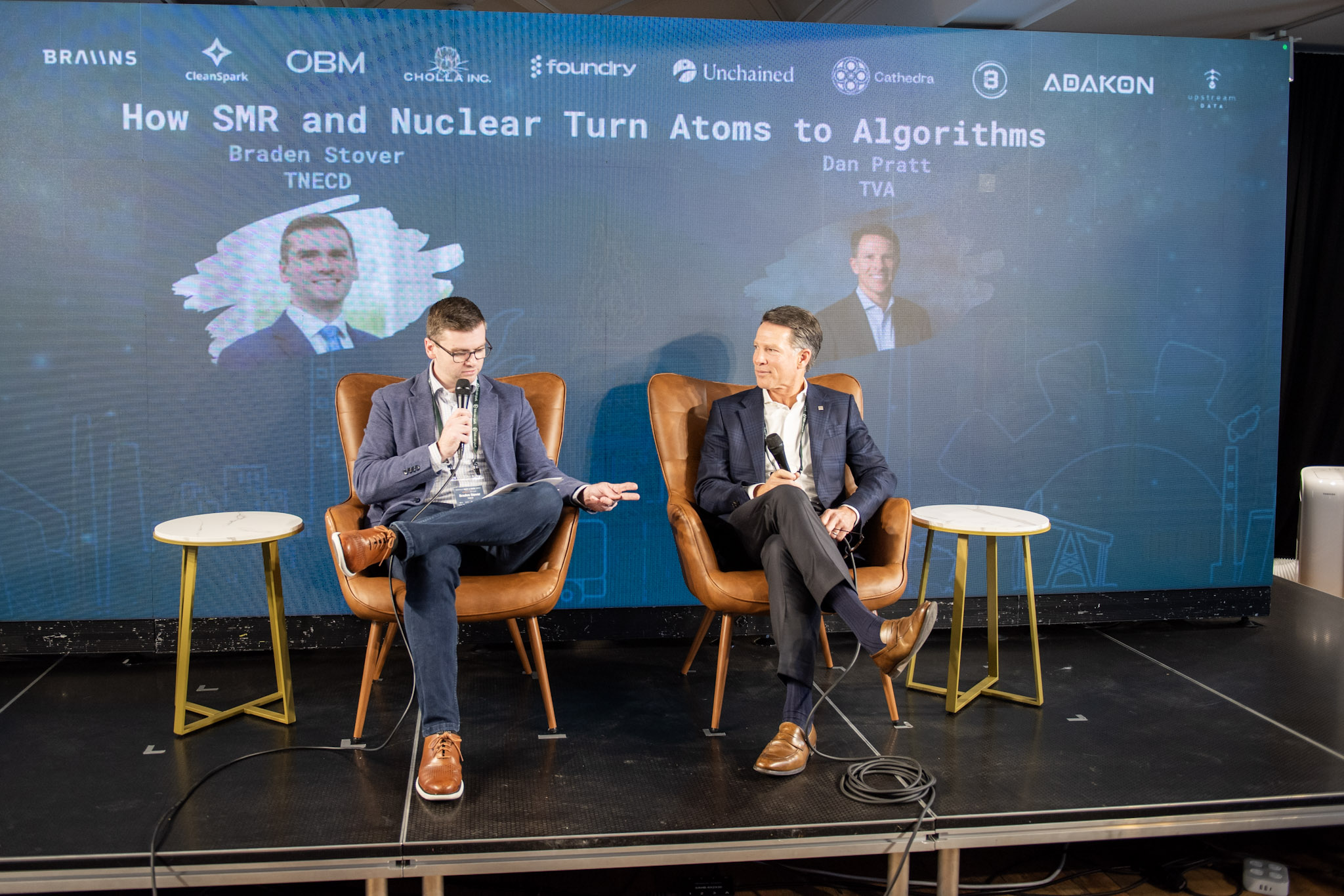
The Tennessee Valley Authority manages one of America's largest electricity grids, serving 10 million people across seven states. When Dan Pratt joined TVA in 2019, the utility had approximately 150 megawatts of flexible load capacity—mostly industrial customers willing to curtail operations during peak demand. Today, through strategic partnerships with Bitcoin miners, that flexibility has grown to 350 megawatts, fundamentally changing how TVA operates its grid.
"What Bitcoin mining has brought to our system is the kind of flexibility that we didn't even know we needed five years ago," Pratt explained at the Nashville Energy & Mining Summit. "These operations can ramp down in seconds, not hours. That capability transforms grid management."
The numbers tell a compelling story about Bitcoin's role in grid stabilization. TVA's mining partnerships don't just provide occasional demand response—they've created what Pratt describes as "constant grid services" that operate 24/7. When renewable generation spikes unexpectedly or demand surges during extreme weather, miners can instantly reduce their load by hundreds of megawatts, giving grid operators crucial breathing room to balance supply and demand.
Braden Stover from Tennessee's Department of Economic and Community Development sees this flexibility as critical infrastructure for the state's economic development strategy. "We're competing with every state in the nation for data centers, advanced manufacturing, and emerging tech companies," Stover noted. "Having proven, scalable grid flexibility gives Tennessee a competitive advantage that most states simply don't have."
Beyond immediate grid benefits, TVA's mining partnerships are informing the utility's nuclear strategy. Tennessee has become ground zero for America's small modular reactor renaissance, with multiple projects in development across the state. Pratt views Bitcoin mining as an ideal complementary load for these future SMR facilities.
"Small modular reactors will generate baseload power 24/7, just like our existing nuclear fleet," Pratt explained. "But unlike traditional reactors that took decades and billions to build, SMRs can be deployed incrementally. Pairing them with flexible loads like Bitcoin mining means we can maximize capacity utilization while maintaining grid stability."
The economic model is straightforward: SMRs produce consistent, carbon-free electricity at predictable costs. Bitcoin miners consume that power continuously, providing guaranteed revenue to justify reactor construction. When grid demand surges, miners curtail operations, freeing up nuclear generation for residential and commercial customers without requiring expensive peaker plants.
Tennessee's approach has attracted national attention from both policymakers and grid operators. Other states are now studying TVA's model, looking to replicate the flexibility gains that come from integrating Bitcoin mining into grid planning. For Pratt, the question isn't whether other utilities will follow TVA's lead—it's how quickly they'll move.
"Five years ago, people thought we were crazy to work with Bitcoin miners," Pratt said. "Now they're asking us how to set up the same partnerships. The data speaks for itself: this works, it scales, and it's making our grid more reliable every day."