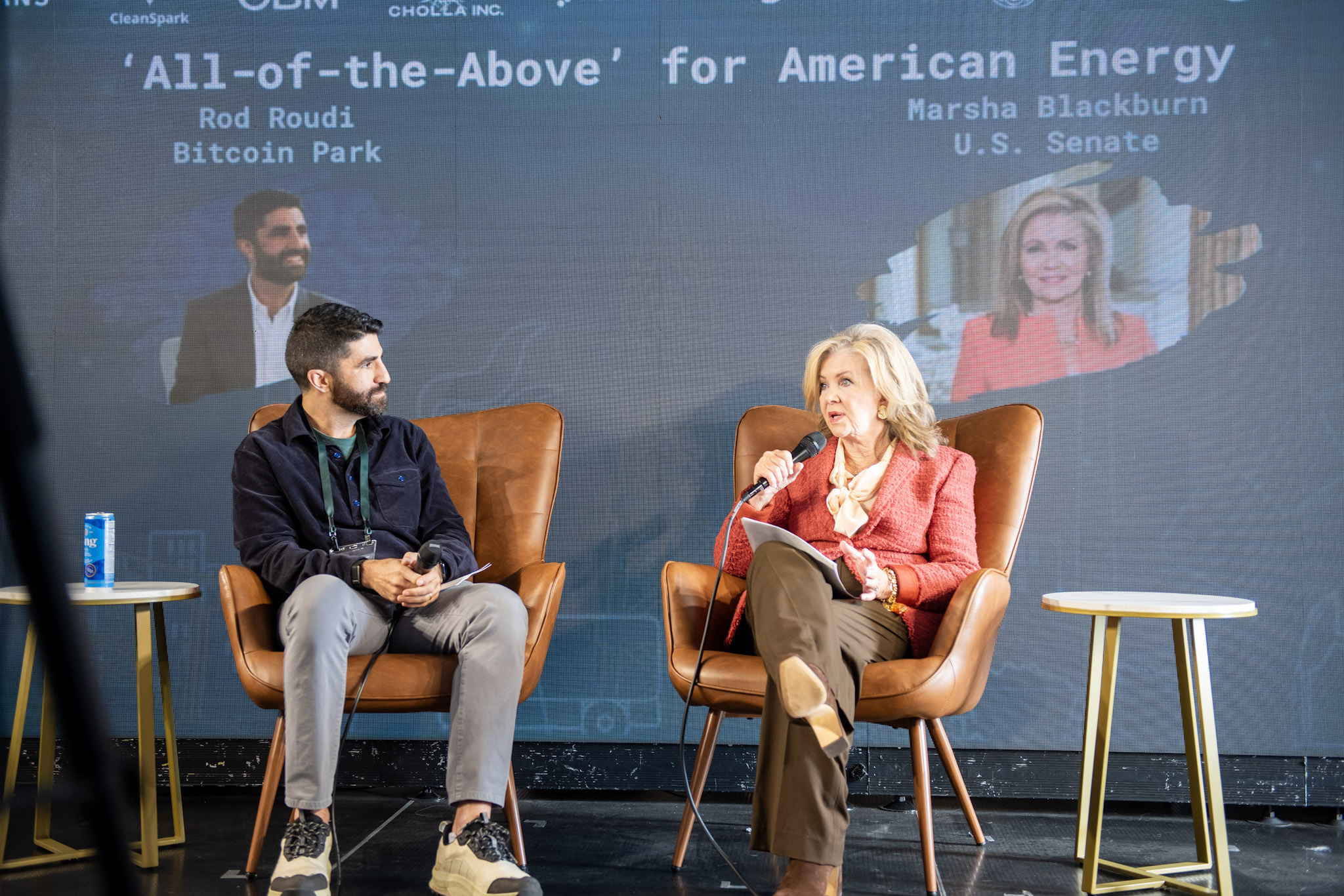
Speaking at the Nashville Energy & Mining Summit, Blackburn argued that meeting the projected energy demands of future loads, such as Bitcoin miners and AI infrastructure requires a broader focus than simply intermittent renewable energy in favor of expanded baseload nuclear generation.
"You're going to get baseload power from one of two sources, coal or nuclear. Both are great," Blackburn told attendees, "Right now, you don't need to be taking coal plants offline until you get nuclear in place."
The senator's remarks come as Tennessee positions itself in competition with States like Wyoming, Ohio, Florida, and Texas for Bitcoin mining and advanced technology investments. Blackburn, who is running for Tennessee governor, framed energy infrastructure as the decisive competitive factor. The Tennessee Valley Authority, which supplies 95.3% of the state's power, will need to generate 30% more energy by 2030 to meet known demand growth, she said.
Blackburn critiqued the Biden administration's renewable energy incentives as inadequate for the consistent power demands of 21st century loads like Bitcoin mining and data centers. She praised the Trump administration's "national energy emergency" declaration on its first day in office, which enabled Congress to redirect Green New Deal tax credits toward traditional fuel production. "Chris Wright, who's the Secretary of Energy, has been great on this," Blackburn said, referring to efforts to replace wind and solar incentives with support for nuclear production.
The energy projections Blackburn cited suggest massive infrastructure investment ahead. Small modular reactors emerged as a focal point, with Blackburn expressing frustration that TVA sat on SMR permit approval for six years under previous leadership. "We've replaced most of that board," she said, noting the president had fired officials "who were not focused on baseload energy."
Beyond energy policy, Blackburn presented Tennessee's tax structure as a recruiting tool. The state has no income tax and no property tax, she emphasized, advantages over competing states like Florida and Texas. She distilled her economic development philosophy into a formula: "Less taxation, plus less litigation, plus less regulation, equals more innovation and job creation."
The senator also highlighted the Trump administration's push for 28-day permit approval timelines, compared to current wait times of 2.5 to 10 years. Streamlined permitting that satisfies state, local, and federal requirements simultaneously would reduce litigation opportunities that slow projects, she argued.
Blackburn's message reflected a broader political realignment around Bitcoin and AI loads. Whether Tennessee's nuclear-focused energy strategy will prove more attractive to Bitcoin miners than other states' approaches remains uncertain. The timeline Blackburn described, 30% more generation by 2030, tripled nuclear output by 2050, suggests a long-term bet that could take years to validate. For now, Tennessee is wagering that baseload power infrastructure, and constructive tax incentives, will determine which states capture the next wave of energy-intensive digital industries.